Professional Photography Lighting Since 1993 X-System 2.4GHz · Worldwide Dealer Network
Controls Hub

One Controls Fabric for Strobe, LED, and Pixel Tube

Godox uses this page to pull one recurring decision thread into the open: how to pair triggers, apps, and DMX bridges across mixed fixture families without a three-brand guessing game.
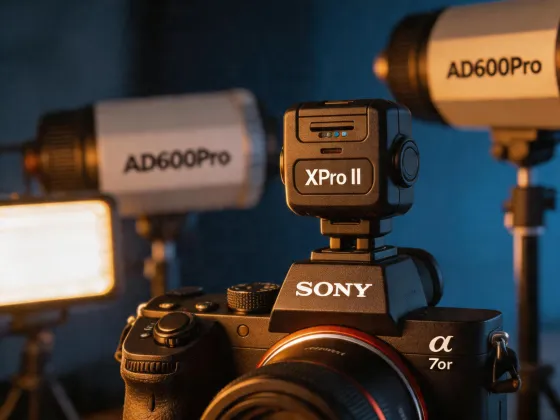
Godox X-system trigger paired with studio strobes

X-System 2.4GHz — One Trigger Across the Kit

The X-system mesh was built so a single XPro II transmitter can address strobes, continuous LEDs, and pixel tubes without swapping receivers on location.

Layer 01

TTL + HSS Path

Auto exposure and high-speed sync (up to 1/8000s) across Canon, Sony, Nikon, Fujifilm, Olympus/OM System, and Panasonic bodies with the matching XPro II variant.

Layer 02

Group & Channel Map

16 channels, up to 5 groups (A–E on most transmitters, A–F on XPro II). Each group can hold mixed strobe and LED fixtures for layered key/fill/rim control.

Layer 03

Firmware & Legacy Support

Older X1 and X2T triggers stay addressable on the same mesh. Firmware keeps shipping for active heads, so older studios can upgrade transmitters without replacing every head.

App & DMX — When You Need More Than a Trigger

Software Layer

Godox Light App & Godox Photo App

Bluetooth control for scene presets, FX programs, and group dimming on LED and tube fixtures. The Godox Photo App complements it on the strobe side. Useful for podcast and broadcast rooms that want to recall the same scene without re-patching.

  • Scene presets per show, per client, or per SKU family
  • FX presets: fire, lightning, TV, candle, fireworks, party
  • Firmware updates pushed through the same app
Hardware Layer

DMX512 Bridge for Stage & Broadcast

TP and TL pixel tubes plus selected ML and KNOWLED heads accept 5-pin DMX for integration with stage consoles and truss-mounted FX cues.

  • DMX-to-2.4GHz bridge for mixed legacy kits
  • RDM discovery on supported heads
  • Art-Net and sACN via third-party node for touring rigs

Compatibility Matrix — Does It Talk to What You Own?

Trigger TTL Bodies Supported Heads DMX
XPro IICanon, Sony, Nikon, Fujifilm, Olympus/OM, PanasonicAD, V, QT, TT, SL, ML, TL, TP familiesVia bridge
X2TSingle-body TTLAD, V, QT, TT, SL, MLNo
X1TSingle-body TTL (legacy)AD, V, QT, TTNo
XT32Manual onlyFull X-system meshNo
Godox Light Appn/a (Bluetooth)SL, ML, TL, TP, LEDPNo

Selection Trade-offs We Talk Through Openly

Three decisions come up on almost every photography lighting build. There is no single correct answer — only a fit for the room, the crew, and the shoot cycle.

Trade-off 01

Wired Controls vs Wireless Controls

Wired (DMX 5-pin): deterministic timing for stage and broadcast, cleaner enterprise integration, no battery maintenance in fixed installs.

Wireless (2.4GHz X-system): lower retrofit disruption on leased studios, faster phased rollout, but requires periodic firmware and transmitter battery checks.

When we push which way: fixed broadcast rooms lean wired DMX; rental fleets and mobile crews almost always lean wireless.

Trade-off 02

Integrated Kit vs Modular Stack

Integrated (single-vendor kit): one SKU family, one warranty ownership, compatibility already verified — fewer things to argue with procurement about.

Modular (mixed heads, triggers, modifiers): easier to swap a failing strobe without replacing the whole kit and to tune per-shoot, but increases commissioning time and training.

When we push which way: education buyers and first-time studios benefit from integrated; rental houses and veteran studios usually want modular with clear X-system addressing.

Trade-off 03

Peak Output vs Color Accuracy & Visual Comfort

Peak output (higher Ws or lumens): freezes motion for fashion and sports, lets you stop down for deep DOF, but can push fan noise and heat up.

Color accuracy and comfort (CRI/TLCI 96+, tight CCT): critical for cosmetics, catalog, and skin-tone work where output past 600Ws is rarely needed.

When we push which way: concert and sports leans output (AD1200Pro); product, portrait, and broadcast leans color fidelity (SL/ML bi-color).

What the X-System Does Not Solve

Honest limits we tell buyers about before they order, not after.

Limit 01

Mixed-Brand TTL Is Not Universal

XPro II transmits TTL only on the matching camera mount. A Sony XPro II cannot pass TTL to a Canon body even when both heads are X-system. Manual and HSS work cross-brand; TTL does not.

Limit 02

2.4GHz Congestion in Stage Environments

In concert venues with dense 2.4GHz traffic (Wi-Fi, IEM, wireless mics), trigger range drops from the nominal 100m to roughly 30–50m and may need channel scanning. DMX or RDM backup is the safer path.

Limit 03

CRI 96+ Holds Only Within Rated CCT

Our LED panels hold CRI/TLCI 96+ across 2700–6500K, but at the extreme ends of green/magenta tint correction the effective color rendering drops. Critical color jobs should sample at the actual target CCT, not the catalog midpoint.

Limit 04

Firmware Lifecycle Caveat

Legacy X1 triggers (pre-2017) stay addressable on the mesh but no longer receive new feature firmware. If you need AF-assist changes or new FX presets, plan an XPro/XPro II upgrade path.

Limit 05

DMX Bridge Is Not Full Art-Net

The native DMX bridge handles 5-pin DMX512 and RDM discovery. Art-Net / sACN for touring rigs still requires a third-party node — we will flag that in the spec review rather than pretend it is built in.

Limit 06

Continuous LED vs Strobe Output Gap

Even ML100Bi at full output delivers less freezing power than a 300Ws strobe. For high-speed fashion or splash photography, continuous LEDs are a fill source, not a key.

Want Us to Map Your Studio to the X-System?

Share the fixtures already on-site, the target bodies, and whether DMX is part of the picture. We will return a group map and firmware plan within three working days.